Curator's Note
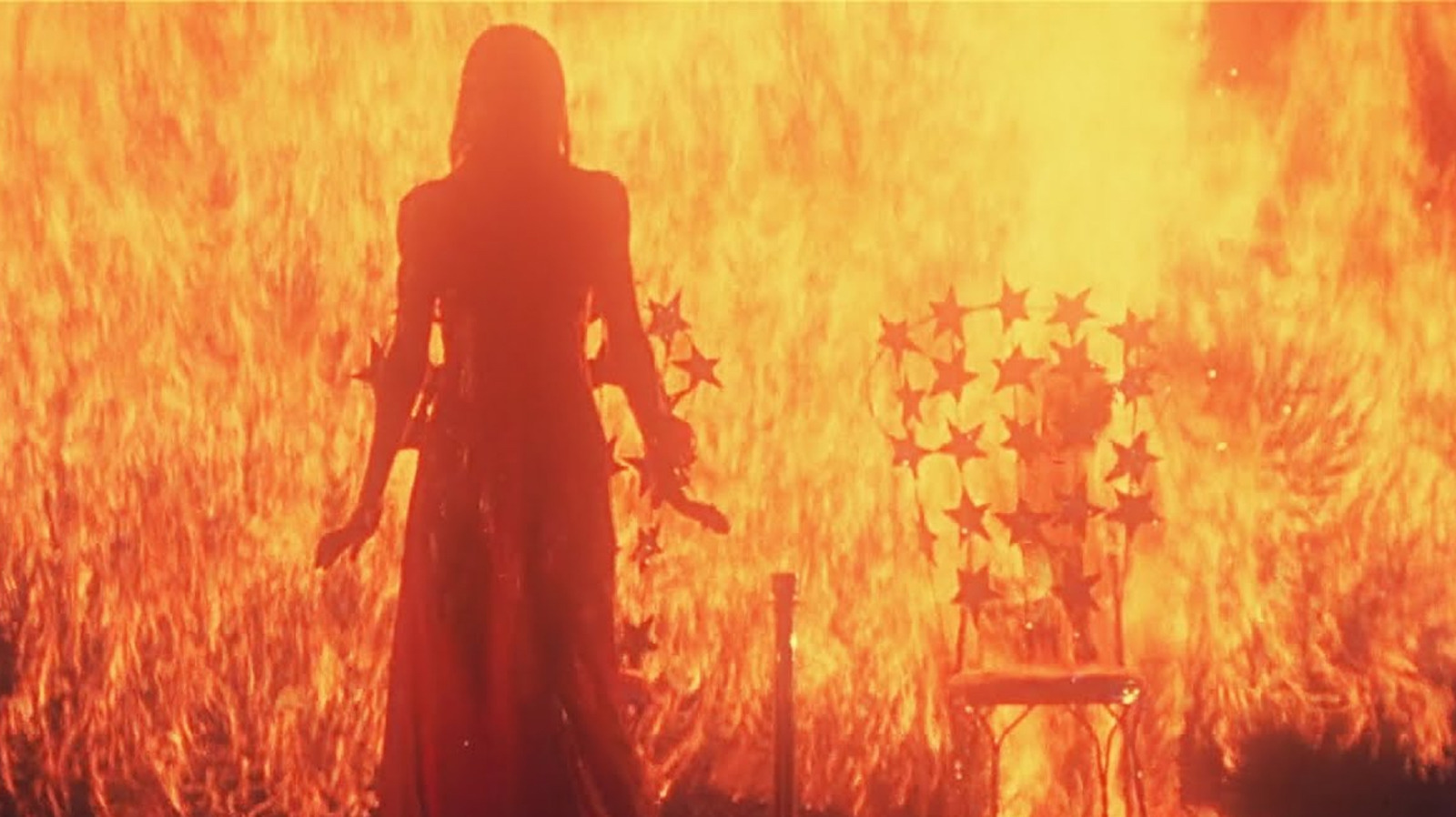

Brian De Palma’s adaptation of Stephen King’s Carrie turns 50 this year, and a question keeps coming to my mind: why do we keep coming back to Carrie? Carrie is a novel, a film adaptation, a sequel, a TV film, a musical, a remake, and now a television series. Carrie has been the subject of countless in-depth analyses by writers such as Abigail Lynn Coykendall, Aviva Briefel, Barbara Creed, Carol J. Clover, Darren Elliott-Smith, David Greven, Robin Wood, Shelley Stamp Lindsey, Simon Brown, Tony Williams[i], and many, many others. What else can be said that hasn’t been said before? Like her hand that emerges from the grave, startling Sue Snell and audiences alike, Carrie refuses stay dead. Fifty years on, she continues to haunt popular culture, reappearing in new adaptations, new readings, and new conversations. So why do we keep coming back to her?
Every few years society is confronted with a tragedy so deeply rooted in misogyny that it provokes outrage and heartbreak. More recently, Carrie has been invoked in popular culture in discussions of Cornell Seven, a 2024 gang rape at Cornell University. Yet Carrie doesn’t appear alone. She is joined by characters like Cassie (Promising Young Woman, 2020), who strike back at patriarchy in an attempt to rectify the harm done to themselves or other women. Popular culture even created a subgenre for these films – the “good for her” movie. These characters are monstrous-feminine[ii] who, monsters or otherwise, refuse their role within patriarchal society and push back against it.
Across generations, cinema has been populated by women like them. We’ve seen the Bride (Bride of Frankenstein, 1935), the Countess Marya Zaleska (Dracula’s Daughter, 1936), Irena (Cat People, 1942) resist the heterosexual unions expected of them. We’ve seen Rosemary (Rosemary’s Baby, 1968) and Joanna (The Stepford Wives, 1975) fight against their husbands who seek control over their bodies. We’ve seen girls like Regan (The Exorcist, 1973) and Charlie (Firestarter, 1984) grapple with extraordinary powers that become intertwined with their changing bodies and experiences of patriarchal oppression. More recently we’ve seen Jennifer (Jennifer’s Body, 2009), Dani (Midsommar, 2019), Grace (Ready or Not, 2019), Pear (Pearl, 2022), hold their own against violence, oppression, and the expectations imposed upon them.
Arguably, these monstrous-feminine figures stand in for unbridled female power and the threat it represents to society, which, as many scholars have argued, is one of the central tenets of horror films. As Creed writes, it is “man’s fascination with and fear of female sexuality [which] is endlessly reworked within the signifying practices of horror films”[iii]. Looking at the examples above, we can see how the monstrous-feminine - this vessel for male anxieties (and also female power) - has changed over time. From the Bride to Pearl, she has worn many faces.
It’s no surprise that the monstrous-feminine has changed faces as she adapts to new cultural contexts. As Stacey Abbott suggests, monsters “speak to our fears and our desires. They embody our past and our future. They express our psyche and our politics but that meaning, like the monster that embodies it, is not fixed. Together they shift and change, responding to a plethora of influences and contexts”[iv]. Yet Carrie is remarkably resistant to this process of change. Since her first appearance in King’s novel and De Palma’s 1976 adaptation she has remained, at her core, the same Carrie. Decades, remakes, and reimaginings have altered the world around her, but they have not fundamentally altered what she represents. As Stephen King puts it, she remains “largely about how women find their own channels of power, and what men fear about women and women’s sexuality”[v]. While the monstrous-feminine changes faces, Carrie keeps the same one. And somehow, she never stops being contemporary.
But the question remains: why do we keep coming back to her? Why do we continue to remake the same character? Kimberly Peirce’s Carrie (2013), for instance, foregrounds cyberbullying and places greater emphasis on the mother-daughter relationship, yet the film ultimately returns to the same concerns with female power and female sexuality. So what is it about Carrie that allows her not only to survive, but to be reborn every few years?
Part of the answer, I argue, lies in the scale of her revenge. Unlike many of her monstrous-feminine counterparts, Carrie’s power is almost limitless. Regan wreaks havoc within the confines of her home. Rosemary attempts to escape the Satanic cult orchestrated by her husband. The Bride rejects Frankenstein’s monster. Irena transforms into a panther. Carrie, however, devastates an entire community. She punishes those who have mistreated her, but she also casts judgement on those who have not. She burns down the school gym and, at least in King’s novel, destroys a large part of the town of Chamberlain itself. Her actions place the audience in an uncomfortable position. We cheer as she punishes those who have tormented her, yet we are also forced to question the morality and scale of her revenge. Carrie is neither heroine nor villain. She remains an ambivalent monster, one whose actions may be morally troubling but are nevertheless understandable.
More importantly, Carrie is not domesticated in the way many of these other characters are. Regan is exorcised and returned to her place within the family and the Church. Joanna is murdered by the Men’s Association. Rosemary ultimately accepts the role of mother imposed upon her. These women are allowed to display power, to challenge the structures around them, and even to threaten them, but they are ultimately contained through narrative closure. Carrie is not. Although her ending is undeniably tragic, it is not dictated by patriarchy, nor is she forced into a socially acceptable role. Instead, she remains defiantly unresolved. As the hand emerging from the grave reminds us, Carrie refuses to stay buried.
So why do we keep coming back to Carrie? Perhaps because, unlike so many other monsters, she has never needed to change and while so many others are ultimately contained, punished, or returned to an acceptable place within the social order, Carrie is never made to conform. Fifty years later, she still stands as a figure of female power that cannot be contained.
[i] Coykendall, A. L. (2000) “Bodies Cinematic, Bodies Politic: The ‘Male’ Gaze and the ‘Female’ Gothic in De Palma's Carrie”, Journal of Narrative Theory, 30(3), 332-263; Briefel, A. (2005) “Monster Pains: Masochism, Menstruation, and Identification in the Horror Film”, Film Quarterly, 58(3), 16-27; Clover, C. J. (1992) Men, Women, and Chain Saws: Gender in the Modern Horror Film. Princeton: Princeton University Press; Creed, B. (1993) The Monstrous-Feminine: Film, Feminism, Psychoanalysis. London: Routledge; Elliott-Smith, D. (2016) Queer Horror Film and Television: Sexuality and Masculinity at the Margins. London: I. B. Tauris & Company; Greven, D. (2011) Representations of Femininity in American Genre Cinema: The Woman’s Film, Film Noir, and Modern Horror. New York: Palgrave Macmillan; Lindsey, S. S. (1991) “Horror, Femininity, and Carrie’s Monstrous Puberty”, Journal of Film and Video, 43(4), 33-44; Brown, S. (2018) Screening Stephen King: Adaptation and the Horror Genre in Film and Television. Austin: University of Texas Press; Williams, T. (2014) Hearths of Darkness: The Family in the American Horror Film. Jackson: University Press of Mississippi; Wood, R. (2003) Hollywood from Vietnam to Reagan...and Beyond. New York: Columbia University Press.
[ii] The term ‘monstrous-feminine’ was coined by Barbara Creed in The Monstrous-Feminine: Film, Feminism, Psychoanalysis (1993).
[iii] Creed, p. 5.
[iv] Abbott, S. (2020) ‘Foreword: Monstrous Everywhere’, in Mann, C. I., Phases of the Moon: A Cultural History of the Werewolf Film. Edinburgh: Edinburgh University Press, p. xi.
[v] King, S. (1981) Danse Macabre. New York: Warner Books, p. 198.
Add new comment