Curator's Note
The Elvis of Punjab - Amar Singh Chamkila - was a regionally renowned Punjabi singer in the 1980s, whose memory had become mostly obscure prior to the release of a biographical Netflix Original movie in 2024. Netflix, as a transnational media platform with an economic incentive to cater to niche audiences and their specific content-consumption preferences, has been at the center of a global shift in media consumption and production practices. Its enormous scale and access to subscriber data allow it to commission niche media content that benefit from economies of scale.[1] Additionally, a unilateral control over all stages (origination, distribution, production and acquisition) of the media chain for its original productions, enables the brand to curate the ‘Netflix Style.’ Through this essay, I discuss Netflix’s employment of glocalizing industrial practices and visual elements in original productions like Amar Singh Chamkila (2024), to benefit from their unique market penetrative capabilities. I argue that the Netflix Style should be examined as a cumulative result of production practices that make media content consumable for the largest possible segment of its subscriber base. Presently, I will only focus upon the utility of textual graphics in the Netflix Style.
Amar Singh Chamkila (2024) benefits from the brand’s data-driven content production for the niche Punjabi audiences, subtitling affordances for global viewing and the Netflix Recommendation System, which boosted its visibility to wider audiences of Bollywood movies, musicals and period pieces. The biopic’s visualization additionally exhibits specific textual elements encoded into the film itself, boosting its transnational appeal.[2] Frédérique Khazoom presents Netflix’s televisuality as a result of its global scaling of the media chain stages, in addition to its deployment of the local language strategy. Khazoom posits that Netflix commissions the production of foreign media content to local studios using the “cost-plus model” to benefit from their localized media production expertise and acquire exclusive rights to distribute it domestically and internationally in exchange for a profit fee.[3] This is also echoed by Deborah Castro who writes that, “Netflix achieved this global reach more quickly by establishing strong alliances with local production companies with proven track records in broadcast television.”[4] Khazoom states that these productions are designed to be “many-to-many i.e., a programme is intended for many audiences around the world from the start.” I explicate Netflix’s employment of textual graphics in Amar Singh Chamkila (2024) to achieve a universal consumption. Castro also notes that period dramas received significant attention from Netflix’s development executives for foreign Netflix productions.[5] Transforming this biopic about a legendary folk singer from India, along with optimal casting choices, into an ideal candidate for the “Netflix Treatment.”
According to a Netflix blog post for the movie’s release event, the film was commissioned as established filmmaker Imtiaz Ali’s streaming debut.[6] Variety reports that the biopic stars renowned Indian singers Diljit Dosanjh and Parineeti Chopra, with the former being nominated for an international Emmy award for his role in this movie.[7] This is in tandem with Castro’s identification of Netflix’s tendency to work with locally celebrated artists and specific auteurs (here Dosanjh is a world renowned Punjabi performer and Ali is nationally recognized for his humanistic directorial pieces). Furthermore, it commissions its media content from recognized studios with the functional capability to abide by its high-quality standards. This movie was produced by Reliance Entertainment Studios, one of the largest film production companies in India showcasing superhit movies like Golmaal (2006) and Singham (2011).
Amar Singh Chamkila (2024) depicts the life and assassination of a renowned Punjabi regional singer by Sikh militants in 1988, who targeted him for the controversial and sexually explicit nature of his lyrics. During a panel discussion at FICCI FRAMES 2024, a prominent trade conference in India, Ali elucidated that these sexually explicit songs were an important motif in this film. The Variety article mentions that “All the songs performed by Chamkila and his band in the film are rendered live by Dosanjh and his troupe.”[8] That is, this movie’s rendition of Chamkila’s songs were recorded live with Punjabi artists who performed together and in response to each other, unlike the industrial practice of studio mixing individually recorded performances and dubbing them later for wider audiences. This directorial decision was intended to preserve the authenticity of the performances, but it created a linguistic problem. The songs are performed in Punjabi, while the film is designed for circulation beyond a Punjabi-speaking audience. The biopic evades this conundrum by employing textual graphics, which are often present in Ali’s films. In the next section of this essay, I will analyze the visuality of the scene performing the song “Mitra Mai Khand Ban Gayi” (Beloved, I have become sugar).
Mitra Mai Khand Ban Gayi
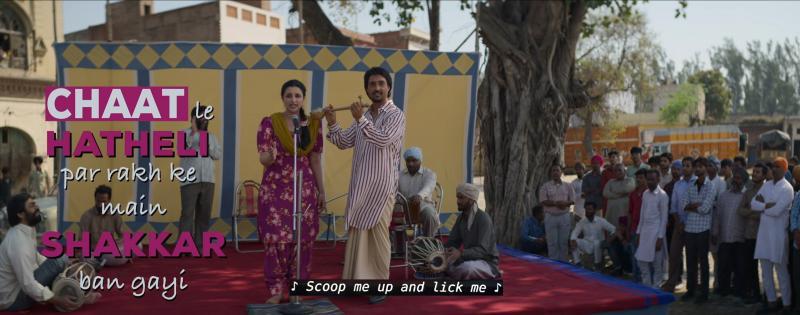
The scene starts at the 52-minute mark, and depicts the first duo performance of Chamkila and his wife, Amarjot Kaur. A wide shot of the stage shows the duo performing this Punjabi song surrounded by audience members. Superimposed upon this shot is a graphic text, translating the Punjabi song into Hindi (or Hinglish). At the same time, the subtitles of the scene translate the song into English (refer image). Thereby showcasing three distinct meanings for the same script in Punjabi (through the audio), Hindi (through superimposed graphics) and English (through the subtitles). The Hindi and Punjabi translation for this stanza is “Lick me like I am sugar on your palm.” Amresh Sinha states that a successful translation is one that “has managed to transparently incorporate the essence, the universal sense of meaning, of the source language [Punjabi here] into the target language [Hindi here].”[9] Additionally, Hanem El-Farahaty mentions that Netflix uses “retention, direct translation and substitution” strategies while translating a foreign language for English subtitles.[10] In this sequence, the Hindi translation retains more of the cultural specificity of the Punjabi lyrics, while the English subtitle employs cultural substitution to make the reference more accessible to audiences unfamiliar with the original context. The English subtitle flattens the metaphor into a sensory action. The Hinglish graphic retains the evocative cultural metaphor of licking sugar (shakkar) from an open palm (hatheli). The result is not simply translation from one language to another, but the simultaneous production of different degrees of cultural accessibility. But this raises the question, why was Hinglish used here instead of Hindi?
Hinglish for Optimal Market Penetration
Amar Singh Chamkila (2024) employs an alternative approach by Netflix to the local language strategy for the Indian market, in response to its 22 officially recognized languages. By accompanying a Hindi translation, alongside the English translated subtitles, Netflix has expanded its reach from a Punjabi audience, towards pan India accessibility. The usage of Hinglish, which is the phonetic representation of Hindi using English alphabets, signals Netflix’s focus on India’s abundant English-speaking audiences. Ramon Lobato while writing about Indian audiences mentions that “Netflix is reliant on the pulling power of its original content among English-speaking elites.”[11] Hence the employment of Hinglish transliteration strategies evidences the movie’s attention towards the wider urban audiences of India that are more comfortable with English but are often conversational in Hindi, which is taught as a third language in many states in India. More importantly, this upper consumer strata can afford the platform’s higher subscription fee in comparison to that of cheaper (and local) competitors like JioHotstar, Zee5, SonyLIV and KableOne. Additionally, Hinglish would ease consumption friction amongst the widespread Hindi-speaking (not necessarily Hindi literate) diaspora across the world. Thereby optimizing the film’s marketability to global audiences of Bollywood.
The Netflix Style, therefore, should not be understood solely as a recognizable visual aesthetic shared across Netflix productions. Instead, it can be understood as a cumulation of industrial and production practices that make media accessible across multiple audience segments. Localization consequently becomes more than an industrial practice, becoming embedded within the text itself.
[1] Lotz, Amanda D, and Ramon Lobato. 2023. Streaming Video. NYU Press: 23.
[2] Frédérique Khazoom. 2025. “Televisuality on a Global Scale: Netflix’s Local-Language Strategy.” Media and Communication no.13: 12. https://doi.org/10.17645/mac.9356.
[3] Frédérique Khazoom. 2025. “Televisuality on a Global Scale: Netflix’s Local-Language Strategy.” Media and Communication no.13: 5. https://doi.org/10.17645/mac.9356.
[4] Lotz, Amanda D, and Ramon Lobato. 2023. Streaming Video. NYU Press: 143.
[5] Lotz, Amanda D, and Ramon Lobato. 2023. Streaming Video. NYU Press: 146.
[6] “Next on Netflix: Blockbuster Entertainment Ka next Level - about Netflix.” 2024. About Netflix. 2024. https://about.netflix.com/en/news/next-on-netflix-india-blockbuster-entertainment-ka-next-level.
[7] Ramachandran, Naman. 2024. “Amar Singh Chamkila Director on A.R. Rahman, Diljit Dosanjh Film.” Variety. May 3, 2024. https://variety.com/2024/film/asia/amar-singh-chamkila-imtiaz-ali-ar-rahman-diljit-dosanjh-netflix-1235988277/.
[8] Ramachandran, Naman. 2024. “Amar Singh Chamkila Director on A.R. Rahman, Diljit Dosanjh Film.” Variety. May 3, 2024. https://variety.com/2024/film/asia/amar-singh-chamkila-imtiaz-ali-ar-rahman-diljit-dosanjh-netflix-1235988277/.
[9] Atom Egoyan, and Ian Balfour. 2004. Subtitles: On the Foreignness of Film. MIT Press: 180
[10] Hanem El-Farahaty, and Rafat Y Alwazna. 2024. “Translating Cultural References and Sensitive Elements between Arabic and English: Netflix Subtitles as a Case Study.” SAGE Open no. 14: 2. https://doi.org/10.1177/21582440241258293.
[11] Lobato, Ramon. 2019. Netflix Nations: The Geography of Digital Distribution. New York: New York University Press: 122.
Add new comment